Pantry pest outbreaks in Middle Tennessee frequently occur due to warm interior relative humidity that accelerates insect life cycles. In historic bungalows throughout East Nashville and 12 South, as well as newer…
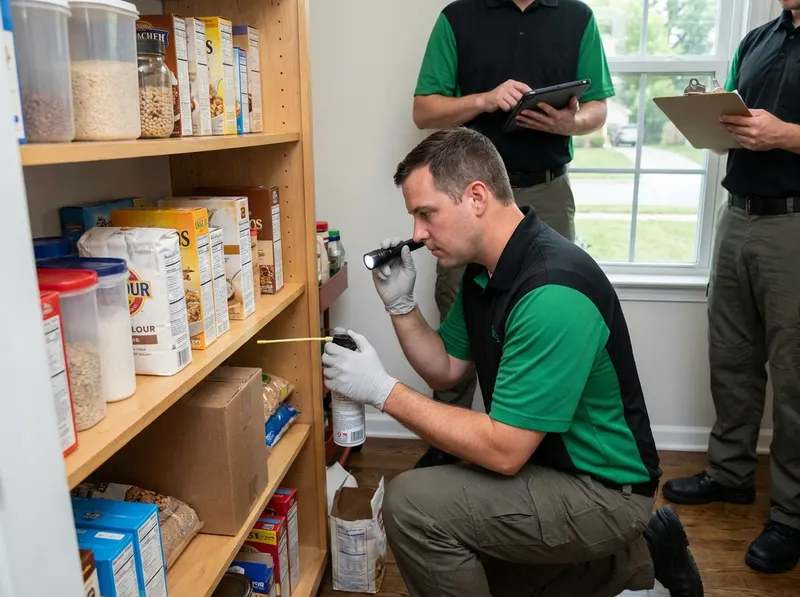
Pantry pest outbreaks in Middle Tennessee frequently occur due to warm interior relative humidity that accelerates insect life cycles. In historic bungalows throughout East Nashville and 12 South, as well as newer builds in The Nations and Germantown, stored product pests breach structures inside commercially packaged milled grains, dry pet feed, birdseed, and dried spices. Eliminating these infestations requires identifying the primary breeding harborage rather than applying general chemical broadcast sprays. RavenStone Pest Guard implements integrated pest management protocols derived from structural guidelines established by the EPA Integrated Pest Management program, strictly focusing chemical placement within structural voids rather than exposed food-contact surfaces.
Controlling stored food insects relies on systematic source extraction paired with localized micro-barrier treatments. The primary target species include the Indian meal moth (*Plodia interpunctella*), which infests coarse flours, cereal boxes, and dried fruits, alongside small coleopterans such as the sawtoothed grain beetle (*Oryzaephilus surinamensis*) and confused flour beetle (*Tribolium confusum*). According to technical biology literature documented by the Purdue University Department of Entomology, female Indian meal moths can deposit up to 400 eggs directly on packaging materials within a 14-day adult lifespan. Our technicians apply botanical desiccant dusts into back-wall junction voids behind cabinetry to establish defensive exclusion barriers while preventing pesticide deposition onto shelving, following workplace safety practices outlined by the OSHA Safety and Health Standards. Technical reference guidelines from the University of Tennessee Extension demonstrate that deep-crevice vacuum extraction reduces larval populations by over 85% prior to residual barrier application.
Targeted treatment is necessary when fine silk webbing, cast larval skins, or wandering adult beetles appear on interior walls in neighborhoods like Sylvan Park, Belmont-Hillsboro, and Crieve Hall. Relying purely on basic retail aerosol sprays creates chemical dispersion hazards without reaching the larvae hidden deep within unopened, pinhole-punctured grain bags. Following containment standards supported by the National Pest Management Association, our methodology isolates infested goods, tracks emerging adults using species-specific pheromones indexed by the Entomological Society of America, and adheres to domestic safety regulations governed by the Tennessee Department of Agriculture.
Executing eradication follows a standardized, chronological sequence:
For suburban residences in Green Hills, Donelson, and Inglewood housing central storage pantries or garage-based pet food reserves, long-term exclusion requires mechanical barrier repair. Structural sealing around utility pipes, pantry electrical penetrations, and lower baseboards prevents migrating larvae from entering adjacent wall voids, referencing pest safety standards maintained by the Centers for Disease Control and Prevention and consumer product protections from the U.S. Food and Drug Administration. Homeowners can reach RavenStone Pest Guard at (629) 319-7851 to schedule a technician visit.
Every job gets a firm, written price after a free on-site visit.
Tell us about your stored product pest control job in Nashville and we'll send a clear, written quote, usually the same day.
 RavenStone Pest Guard