Exterior insect activity throughout Davidson County escalates rapidly due to regional humidity, dense river basin lowlands, and frequent summer precipitation. Residential properties in shaded corridors like Crieve…
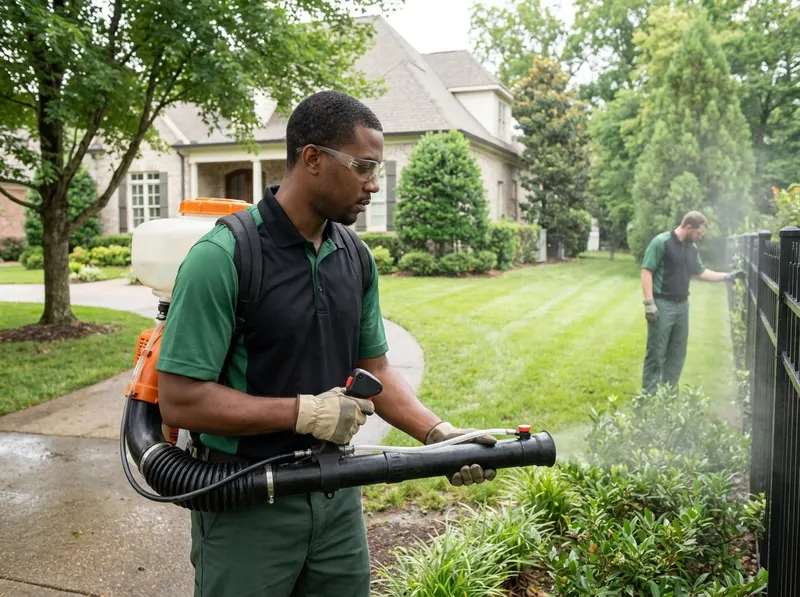
Exterior insect activity throughout Davidson County escalates rapidly due to regional humidity, dense river basin lowlands, and frequent summer precipitation. Residential properties in shaded corridors like Crieve Hall, Sylvan Park, and Belmont-Hillsboro frequently harbor high concentrations of Asian tiger mosquitoes and biting flies. RavenStone Pest Guard implements an integrated pest management strategy that combines botanical-derived synthetic pyrethroids, microencapsulated suspensions, and juvenile hormone mimics. Treatments deliberately bypass open blossoms to avoid non-target pollinators, adhering strictly to Pollinator Partnership conservation standards. Larval suppression in standing drainage features relies on Bacillus thuringiensis israelensis to stop pupation before adults emerge into outdoor recreation zones.
Dense vegetation near the Cumberland River watershed, such as riparian borders bordering East Nashville, Inglewood, and Donelson, creates sustained daytime resting zones for biting Diptera. RavenStone Pest Guard calibrates high-pressure motorized misting equipment to coat the undersides of broadleaf shrubs, ground ivy, and low-hanging tree canopies up to 10 feet. This mechanical placement adheres to OSHA safety regulations for professional pesticide handling and matches guidance from the Entomological Society of America. The microencapsulated compounds bond to exterior foliage, resisting wash-off from routine rains while degrading safely into non-toxic soil elements without migrating into municipal storm drains.
Properties near urban drainage easements in Germantown, 12 South, and The Nations encounter persistent fly populations originating from wet decaying organic waste and shaded soil margins. Suppressing biting stable flies requires non-chemical cultural adjustments alongside structural exterior surface sprays under deck boards, soffit lines, and fence perimeters. Technicians cross-reference regional mosquito vector indices provided by the Tennessee Department of Health to address regional threats like West Nile virus. When urban runoff ponds in low-lying zones, property owners can reference municipal guidance from the Metro Water Services Stormwater Division to resolve structural grade pooling.
Executing a multi-tiered exterior suppression plan follows an operational sequence to establish multi-week suppression across outdoor living areas:
Deciding between a standalone single-event application and a seasonal multi-barrier rotation depends on neighborhood tree canopy density and local hydrology. Properties in heavily wooded sections like Green Hills require recurring treatments every 21 to 28 days to maintain uninterrupted chemical barriers, whereas isolated urban lots may only require seasonal pulse treatments. The trade-off centers on environmental exposure versus residual longevity; intense sunlight and frequent afternoon storms break down exterior residuals faster than covered installations, which necessitates routine inspection intervals under National Pest Management Association guidelines and environmental application caps enforced by the Tennessee Department of Agriculture.
Every job gets a firm, written price after a free on-site visit.
Tell us about your exterior mosquito and biting fly suppression job in Nashville and we'll send a clear, written quote, usually the same day.
 RavenStone Pest Guard